AI Overviews pull from pages that already rank, which is good news and bad news
Good news because the work is not separate: ranking well is the entry condition. Bad news because being on page one is no longer sufficient, and the page that gets quoted inside the overview is frequently not the one at position one.
Ranking got you to the door, not through it
The old arrangement was simple. Rank, get clicks, done. An overview changes the arithmetic: the answer appears above the results, the user often has what they needed, and the only visibility left is whether your site is one of the sources named.
Which means two separate things now have to be true. Your page has to rank well enough to be in the candidate set, and it has to contain a passage worth lifting into the answer. Most SEO advice covers the first and nothing covers the second, which is why sites that rank well find themselves watching their own content summarised with someone else's name on it.
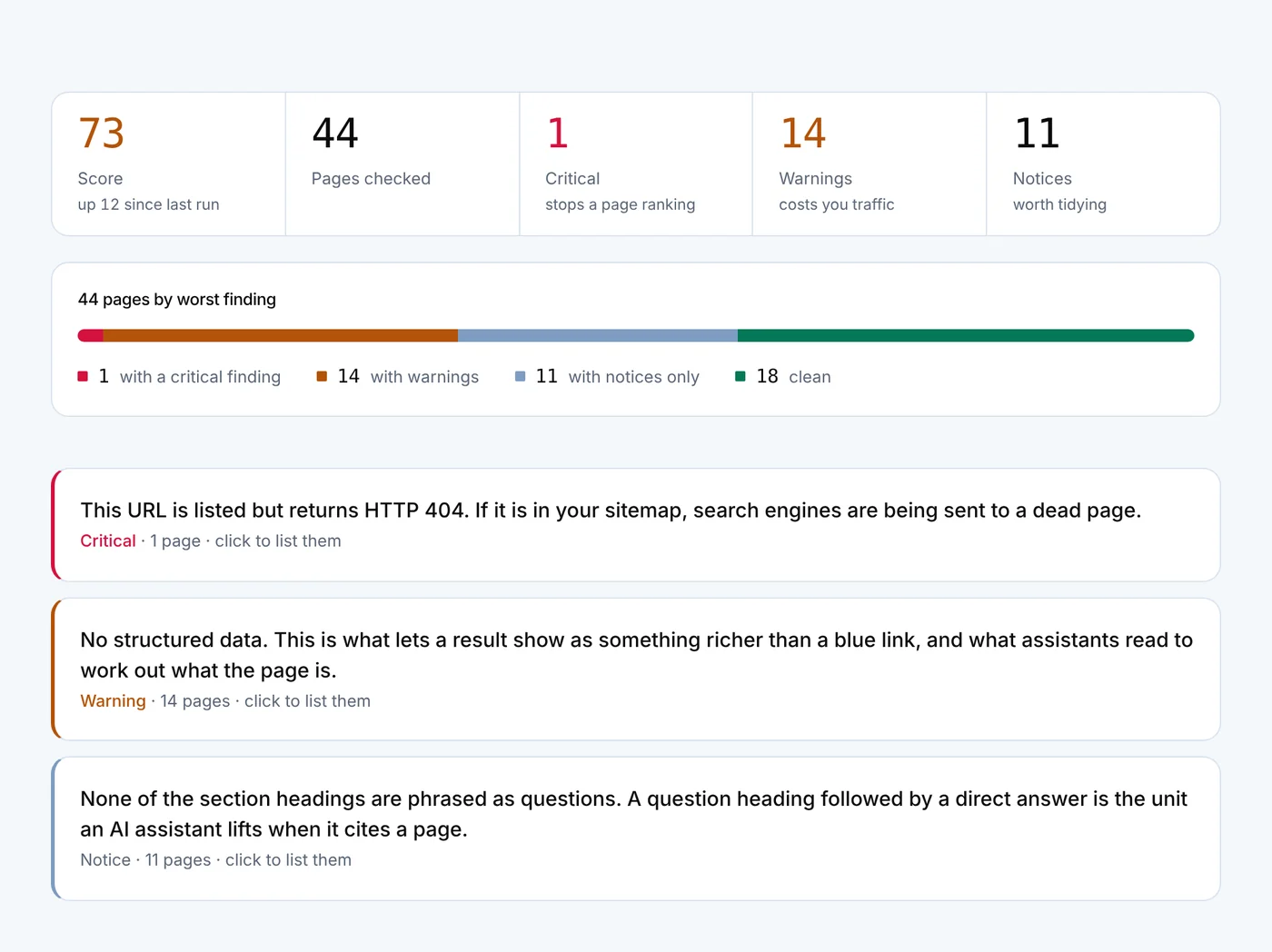
The second condition is structural and measurable, which is the whole reason this page exists.
What to do about it
The ranking half is ordinary SEO. The other half is the four signals, and they are the part nobody is doing.
- Keep ranking
- Nothing here replaces that. If the page is not in the candidate set, none of the rest applies.
- Put the answer where it can be lifted
- First paragraph, stated plainly. An overview assembles from passages, and a passage that needs three paragraphs of setup is not one.
- Match the question in a heading
- Headings phrased as questions give the assembler something to align a query against.
- Be specific enough to be worth naming
- A source is cited when it supplies something the summary could not otherwise state. General advice supplies nothing.
- Measure it rather than guessing
- The free GEO checker scores any page on all four and tells you which one it fails.
Score a page free and see whether it contains a liftable answer.
Score a page freeThe four things the scorer measures, and why those four
An assistant answering a question does not read your page the way a person does. It is looking for a passage it can lift and attribute. Four properties decide whether your page contains such a passage, and all four are structural rather than stylistic, which is why they can be measured rather than judged.
A direct answer in the opening. If the first paragraph restates the question, sets context and promises an answer later, there is nothing to lift from it. The answer has to be in the first hundred words or so, stated plainly, before the caveats.
Headings phrased as questions. An assistant matching a user's question against your page matches most readily against a heading that is itself that question. Our own audit of langoli.com found thirty-three pages with not one question-phrased heading on them, which is typical rather than unusual.
Answers sitting directly under their questions. A question heading followed by two paragraphs of preamble breaks the pairing. The answer has to be the first thing under the heading, which is a formatting discipline more than a writing one.
Specific facts a reader could check. Numbers, dates, named entities, concrete claims. A page of general advice has nothing to quote; a page stating that the llms.txt v2 spec is dated 10 August 2026 does. This is the signal that filler content fails hardest: scoring a filler article on this dimension took its score from 74 to 45 once the measure was corrected.
On the traffic question, honestly
Published studies of click-through rates in the presence of AI Overviews disagree with each other, and the honest summary is that the effect varies enormously by query type and that the numbers are contested. Informational queries where the overview fully answers the question lose the most. Queries where someone needs to do something, buy something or compare options lose much less, because the overview cannot complete the task.
The practical implication is about which keywords are worth your time rather than about whether to continue. Content targeting questions with a short factual answer is worth less than it was. Content targeting decisions, comparisons and tasks is worth roughly what it was, and the overview often sends the reader onward.
Anyone quoting you a precise percentage decline should be asked which study, which query types and which market. The variation between those is larger than the headline number.
What nobody can promise here
Inclusion in an overview. Google does not publish the selection criteria, they change, and the same query can produce different sources on different days.
That this work recovers lost clicks. If an overview fully answers a question, being cited in it earns a mention rather than a visit.
Measurement of whether you currently appear in overviews. That needs polling Google per query, which this product does not do.
Faster indexing. IndexNow reaches Bing, Yandex, Seznam and Naver. Google does not participate.
Visorank scores every draft on these four before it publishes.
Score a page freeQuestions worth asking first
Can I opt out of AI Overviews?
Not selectively while remaining in normal results. The controls available affect snippets and preview length generally, so blocking the overview tends to mean weakening your ordinary listing too. For most sites that trade is a bad one.
Do overviews cite the top-ranking page?
Often not. Sources named in an overview frequently sit below the top result, which is the practical evidence that the selection is about passage quality rather than position alone. That is the opening for a smaller site.
Is this different from optimising for featured snippets?
Closely related and not identical. Both reward a direct answer placed where it can be extracted. The difference is that an overview synthesises several sources rather than lifting one, so being specific enough to contribute something the others do not matters more.