Your customers search in two languages. Most tools assume one
A business in Dubai or Abu Dhabi is found through Arabic queries and English queries, by different people, often for the same product. That is not a translation problem. It is two keyword sets, two sets of competitors, and two bodies of content.
Why translating the site is not the answer
The intuitive move is to write everything in English and translate it. It rarely works, because the Arabic queries are not translations of the English ones. People phrase problems differently in different languages, the intent behind a phrase shifts, and the competitors holding each set are not the same companies.
Running the English keyword list through a translator produces Arabic pages targeting phrases nobody types. They read correctly and rank for nothing, which is the most expensive kind of failure because it looks like work was done.
The second difficulty is volume. Doing this properly means maintaining two content operations, and almost nobody at a small company has time for one.
What running two languages actually takes
The product's answer is that language is a property of the site, and a site can be set up per language.
- Research per language, not per translation
- The expansion runs against Arabic results for the Arabic site and English results for the English one, so each list comes from what people actually type in that language.
- Two sites, one account and one plan
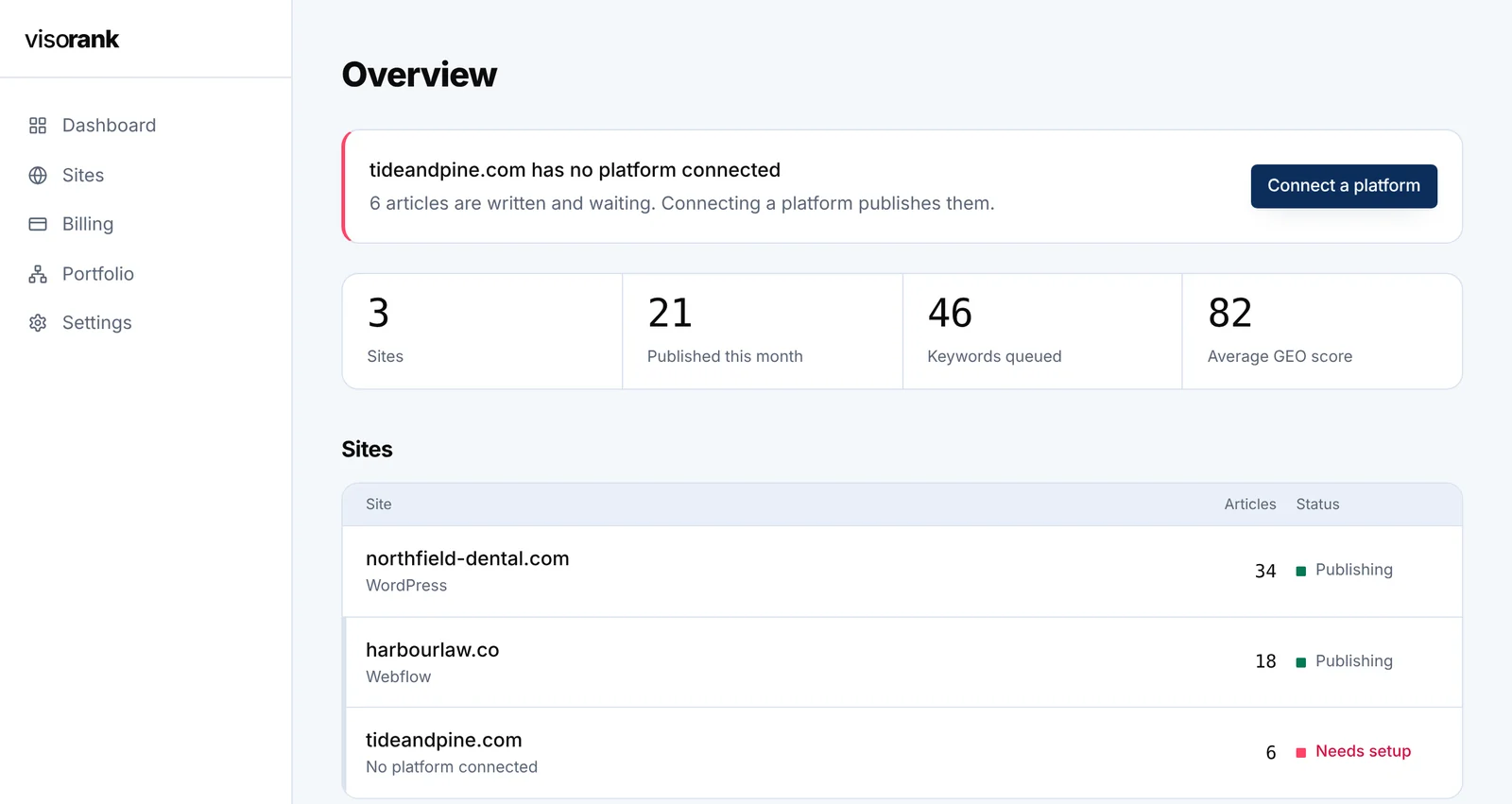
- Run the Arabic and the English site side by side without paying twice.
- Articles written in the language, not converted
- Each draft is written against its own research rather than translated after the fact.
- An audit that covers both
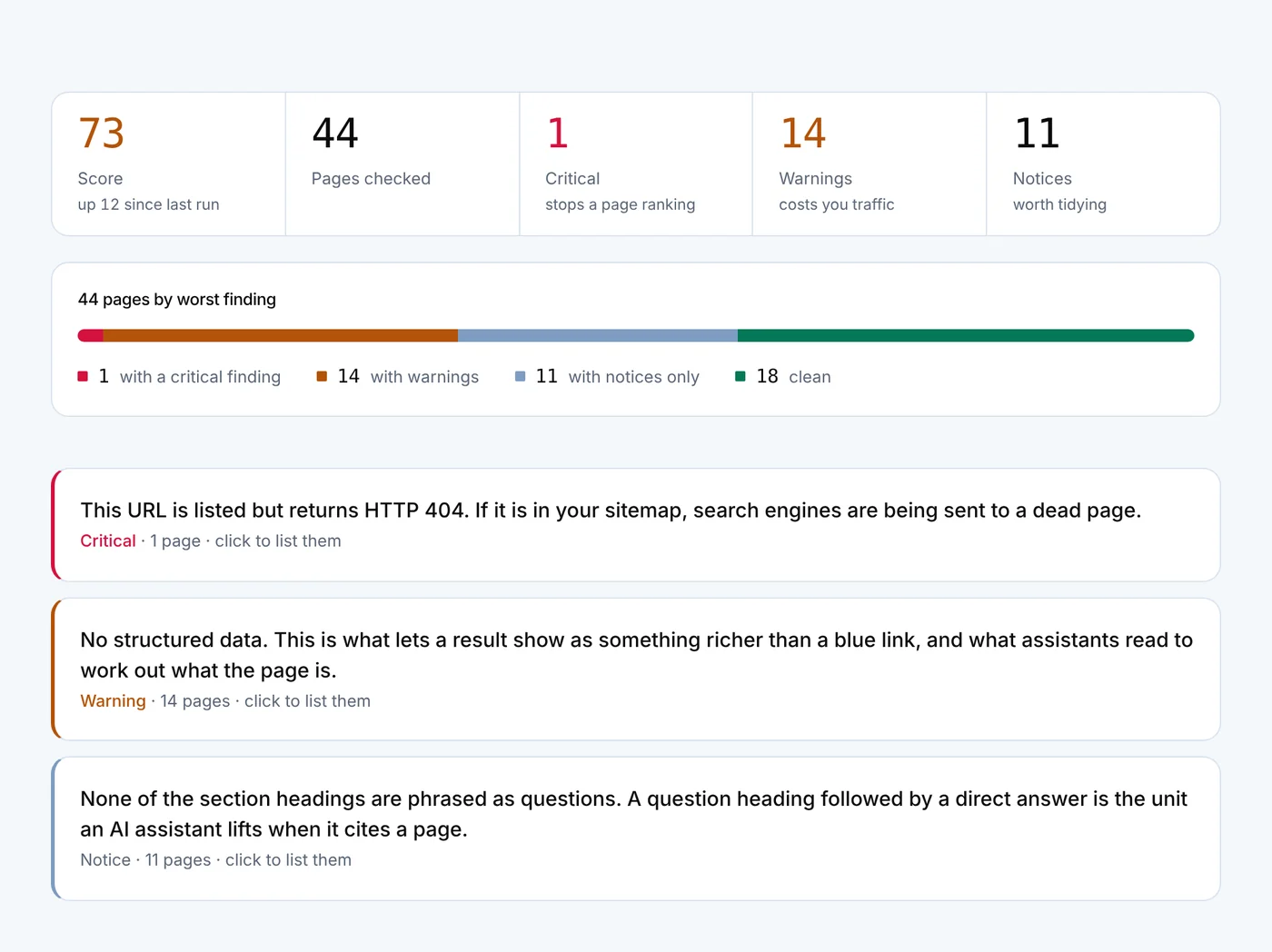
- Including whether your hreflang is correct, which on a bilingual site is the thing most often quietly broken.
- Scored for AI citation before publishing
- Whether an assistant can lift an answer out of the page. Assistants answer in both languages and the structural rules are the same in each.
Run the free audit and check whether your two languages are competing.
Start freeWhat this category charges
Most of it converges on $99 a month, and nothing about the products explains why.
The hreflang mistake that costs bilingual sites the most
A bilingual site tells search engines which version serves which language through hreflang tags. Get it wrong and you get the worst outcome available: the two versions compete with each other, and a searcher is served the language they do not read.
The three failures worth checking by hand. Tags that point at pages which do not exist, which makes search engines discard the whole set. The same language code used twice pointing at different URLs, same result. And a missing x-default, which decides what happens to a visitor whose language you do not offer.
There is a free hreflang generator on this site, and the audit reports these three specifically. Worth ten minutes before any new content, because no amount of publishing fixes a site whose two halves are cancelling each other out.
What this will not do
It will not tell you which language your buyers use. That is your knowledge of your own customers, and it differs by sector in this market more than people expect.
It does not handle right-to-left layout on your site. The articles publish as content; how your theme renders Arabic is your theme's job.
It does not build backlinks, by choice, in any market.
It does not get pages into Google faster than Google wants them.
One language done properly beats two half-maintained.
Start freeQuestions worth asking first
Should I start with Arabic or English?
Whichever your buyers use, which is usually a question about sector rather than about the country. Start with one, do it properly for three months, then add the second. Two half-maintained languages lose to one that is current.
Do I need separate domains for each language?
No. Subdirectories on one domain are the simplest arrangement and keep whatever authority you earn on a single domain. Separate domains split it, and are rarely worth the complexity for a business of this size.
Does AI search work differently in Arabic?
The structural rules are the same: a direct answer up front, question-shaped headings, facts that can be checked. What differs is that there is far less Arabic content competing to be the source, which makes being quotable in Arabic easier than in English right now.